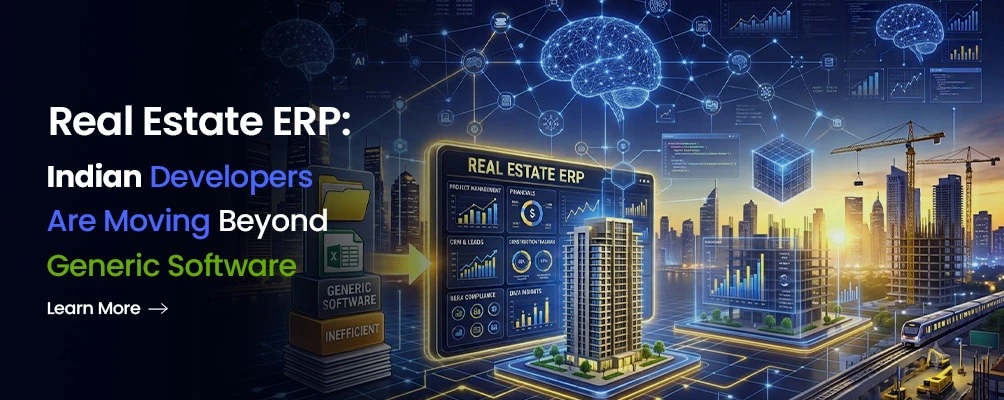
Real Estate ERP: Why Indian Developers Are Moving Beyond Generic Software
If you run a real estate or construction business in India, you've probably reached the same conclusion at some point: your accounting software, your CRM, and your project tracker don't talk to each other — and every month-end close turns into a scramble of spreadsheets, reconciliations, and "can you re-send that report?" emails.
That's the exact gap a real estate ERP is built to close.
In this guide, we'll break down what a real estate ERP actually is, why standard, industry-agnostic ERPs struggle with the realities of property development, and what to look for before you sign a contract — using Farvision, India's construction-grade ERP, as the reference point throughout.
What Is a Real Estate ERP?
A real estate ERP is an enterprise resource planning system purpose-built for the workflows of property development, construction, leasing, and facility management. Unlike generic ERPs designed for manufacturing or retail, a real estate ERP is structured around the way this industry actually works: land acquisition, RERA and regulatory approvals, BOQ-based construction billing, multi-tower revenue recognition, unit-level sales, and long-tail customer collections that can stretch over years.
A true real estate ERP typically brings together:
- Financials — general ledger, accounts payable/receivable, treasury, and fixed assets
- Sales & CRM — lead capture, site visits, bookings, channel partner management
- Materials & Procurement — indents, purchase orders, GRNs, vendor management
- Engineering — BOQ tracking, work orders, contractor billing and certification
- Customer Care — demand notes, collections, complaints, and possession/handover
- HRMS & Payroll — hire-to-retire workflows for site and corporate staff
- Compliance — GST, TDS, RERA reporting, and statutory filings built in, not bolted on
The difference between this and a horizontal ERP isn't cosmetic — it's structural. A factory doesn't have RERA disclosures. A retailer doesn't need cost-to-complete accounting across a 40-storey tower. Real estate has both, and more.
Why Generic ERPs Fall Short for Real Estate and Construction
Most businesses start with either a horizontal ERP (like a generic Tally-plus-add-ons setup) or a patchwork of standalone tools — a CRM here, an accounting package there, an Excel-based project tracker somewhere in between. It works, until the business scales past a certain point. A few common breaking points:
1. Disconnected sales and finance
A standalone CRM can track a lead through to booking, but it can't post that transaction to your general ledger. Someone still has to manually reconcile bookings against collections every month.
2. No native compliance
RERA reporting, GST e-invoicing, and TDS filings are specific to Indian real estate and construction. Generic ERPs treat these as an afterthought or require expensive customisation to bolt on.
3. HR and payroll living in a silo
Standalone HRMS platforms are good at HR, but payroll runs without ever touching the company's books, which means yet another manual entry at month-end.
4. No visibility across the value chain
From land acquisition through construction, sales, customer care, and possession, each department typically works off its own system — so the CFO never gets a single, real-time view of project cash flow.
This is the gap a purpose-built real estate ERP is designed to close — one database, one audit trail, and one source of truth from plot to possession.
What to Look for in a Real Estate ERP
If you're evaluating options, here's a practical checklist:
- Industry-specific workflows, not a generic ERP re-skinned for construction
- RERA, GST, and TDS compliance built into the core product
- A CRM built for real estate — site visits, bookings, cancellations, and channel partner tracking, not a generic sales pipeline
- BOQ-to-bill engineering workflows for contractor certification and progressive billing
- HRMS that posts directly to your GL, not a disconnected HR tool
- Mobile apps and portals for customers, brokers, vendors, and site teams
- Proven deployment at scale, ideally with reference customers in your city or segment
How Farvision Approaches Real Estate ERP
Farvision is a construction-grade ERP built specifically for the real estate and construction value chain, currently used by over 900 real estate and construction firms across more than 30 Indian cities. Rather than treating property development as a variant of manufacturing, Farvision is structured around six verticals that mirror how the industry actually operates: real estate developers, contractors, property/leasing managers, community managers, facility managers, and construction-linked manufacturing.
A few things worth knowing about how it's built:
- Compliance is native, not custom-built. GST filings, e-invoicing, TDS, and RERA reporting are part of the core product for Indian customers, alongside VAT and corporate tax modules for GCC operations.
- Sales and finance share one database. Bookings, demand letters, and collections post directly to the general ledger, so finance teams aren't reconciling a separate CRM against their books every month.
- HRMS ties into payroll and the GL. Hire-to-retire HR workflows, time and attendance, and payroll all sit on the same data model as project financials.
- Leasing gets its own depth. For property and facility managers, Farvision includes a dedicated leasing layer covering lease abstraction, rent escalation, CAM billing, and tenant portals — useful for commercial, mall, and mixed-use portfolios.
- AI is embedded in the workflow, not added as a separate chatbot — surfacing things like cash-flow forecasts, vendor invoice anomalies, and auto-drafted demand letters within existing modules.
Is a Real Estate ERP Worth It?
For a small developer running one or two projects, a lighter combination of tools might be enough. But once a business is managing multiple projects, multiple sales channels, contractor billing, and statutory compliance simultaneously, the cost of not having a unified system — in reconciliation time, compliance risk, and lost visibility — usually outweighs the cost of implementing one.
The clearest signal it's time to move: if your finance team is still exporting data to Excel to reconcile what sales, engineering, and HR each recorded separately, a real estate ERP isn't a nice-to-have anymore.
Final Thoughts
A real estate ERP isn't just accounting software with a new label — it's a system designed around how land is acquired, how projects are billed, how units are sold, and how compliance actually works in this industry. If you're evaluating options, look past the feature list and ask whether the platform was genuinely built for real estate and construction, or adapted from something else.
Farvision has spent close to three decades building specifically for this industry, and today runs on the books of some of India's largest developers, contractors, and property operators.
FAQs
A real estate ERP is structured around how the industry actually works — land acquisition, RERA approvals, BOQ-based construction billing, multi-tower revenue recognition, and long-tail collections — rather than adapted from a manufacturing or retail template. That difference shows up in native compliance, real-estate-specific CRM workflows, and finance that's connected to sales from day one.
Not always. A lighter combination of tools can be enough at that scale. It's once you're managing multiple projects, multiple sales channels, contractor billing, and statutory compliance at the same time that the cost of not having a unified system — in reconciliation time, compliance risk, and lost visibility — starts to outweigh the cost of implementing one.
Look for GST reporting and e-invoicing, TDS/26QB filings, and RERA reporting built into the core product — not bolted on as expensive customisation. For GCC operations, the equivalent is VAT (FTA), corporate tax, and WPS/EOSB compliance.
Want to See How It Works for Your Business?
Book a 30-minute demo with Farvision to see the platform mapped to your specific vertical.
Book a demo →